Table of Contents
CHAPTER 1: The Garland and the Glare
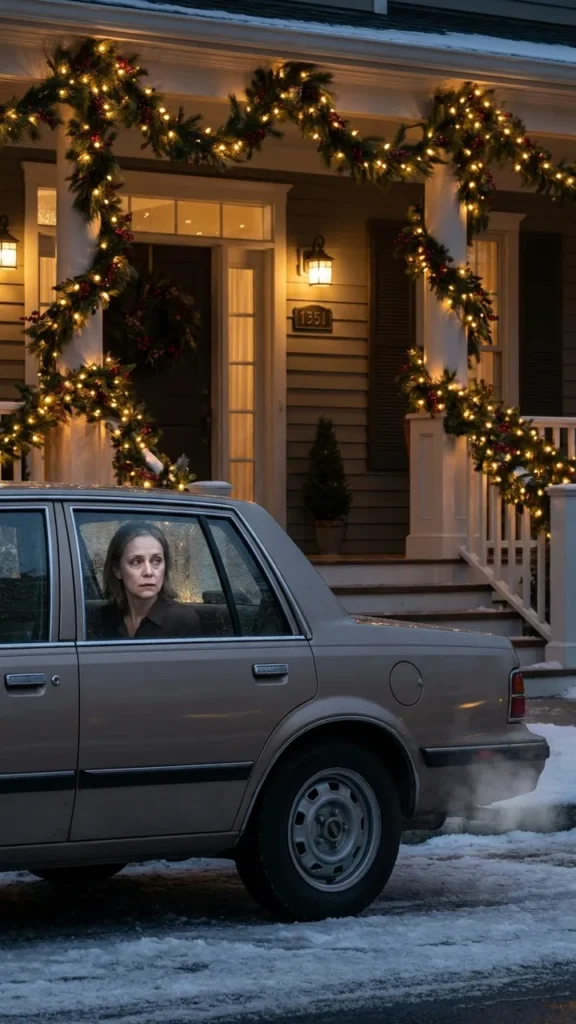
Martha’s porch gleamed.
A shimmering garland, thick with pine and dusted with artificial snow, cascaded down the railing.
Cinnamon, sharp and sweet, cut through the crisp autumn air.
She hummed softly, her movements precise as she adjusted a bauble.
Martha was a neighborhood legend.
Her holiday displays were the stuff of local lore.
Eleanor watched from her car.
The engine idled.
A long, shuddering sigh escaped her lips.
Her hands, bone-dry and cracked, tightened on the steering wheel.
The leather felt slick with a faint sheen of sweat.
Later, the sterile scent of lemon polish assaulted Eleanor’s senses.
Her home was a monument to order.
Every surface gleamed.
Every cushion lay at a perfect angle.
Richard stood by the fireplace, a dark silhouette against the muted grays and whites of the room.
He held a letter, his knuckles white.
“Another frivolous expense, Eleanor.” His voice was a low growl.
It scraped against the quiet. “We have priorities.”
His eyes, like shards of ice, bored into her.
They held no warmth, no flicker of empathy.
Just a cold, hard judgment.
Eleanor flinched inwardly.
Her stomach twisted.
She clutched her hands together in her lap, her nails digging into her palms.
The soft fabric of her slacks did little to soothe her.
“It was just a small purchase, Richard,” Eleanor began, her voice barely a whisper.
It caught in her throat.
She cleared it, trying to sound stronger. “A new set of gardening gloves.
Martha was selling them at the craft fair.”
Richard scoffed.
The sound was sharp, dismissive. “Craft fairs.
Gardening.
Such vital pursuits when the quarterly reports are due.
Do you even understand the pressure I’m under?”
He took a step closer.
The air around him seemed to vibrate with his displeasure.
Eleanor shrank back in her chair.
The plush velvet felt suddenly unforgiving.
“I… I try to help where I can,” Eleanor stammered. “Little things.
To make things… pleasant.”
“Pleasant?” Richard’s laugh was a harsh bark. “Eleanor, we are not aiming for ‘pleasant.’ We are aiming for success.
For dominance.
Your focus is entirely misplaced.
It’s a constant drain.”
He tossed the letter onto a side table.
It landed with a soft thud.
Eleanor’s gaze flickered to it, then back to his face.
His jaw was set.
A muscle twitched in his cheek.
“The savings account, Eleanor,” Richard continued, his voice hardening. “Did you touch it?
For your… hobbies?”
Eleanor’s throat tightened.
She swallowed hard.
The dryness was agonizing. “No, Richard.
Of course not.”
“Good.” He pointed a finger at her.
It was a weapon. “Because that money is for our future.
For *my* future.
Not for your trinkets and your neighborly silliness.”
He turned away then, as if dismissing her entirely.
Eleanor watched his broad back.
The silence that followed was deafening.
It was a heavier burden than any of his words.
Her hands began to tremble.
She tried to still them, to hide the tremors from his unseen gaze.
Martha’s garland, so bright and cheerful just hours ago, felt like a distant, unattainable dream.
The scent of pine and cinnamon had long since faded, replaced by the sterile, suffocating smell of her own home.
The worn vinyl of the diner stool would offer little comfort.
The sharp tang of fried onions would be a welcome distraction.
Anything but this suffocating perfection.
Anything but his glare.
CHAPTER 2: The Diner’s Grim Confession
Eleanor sat at a small diner counter.
The worn vinyl of the spinning stool was cool beneath her.
The air was thick with the smell of stale coffee.
It mingled with the sharp, lingering scent of fried onions.
Her knuckles were white.
They gripped the edge of the Formica tabletop.
Brenda, the waitress, moved with a practiced weariness.
Her apron was a faded blue.
She wiped down the counter.
Her movements were economical.
She had seen it all.
“Another slice of pie, hon?” Brenda asked.
Her voice was rough, like sandpaper.
Eleanor shook her head.
Her throat felt tight. “No, thank you, Brenda.”
A tremor ran through Eleanor’s hands.
She clasped them together.
She tried to still them.
It was no use.
“Rough morning?” Brenda inquired.
She didn’t pry.
She just observed.
Her eyes, crinkled at the corners, held a deep well of understanding.
Eleanor’s gaze drifted to a smear of grease on the counter.
It was a dark, unsightly mark.
It felt familiar. “He makes me feel… ashamed.” The words were barely a whisper.
They were swallowed by the diner’s low hum.
Brenda paused her wiping.
She leaned on her rag. “Ashamed of what, sweetie?”
Eleanor swallowed hard.
Her eyes welled up.
She blinked furiously. “For wanting things to be nice.
For the little things I do.” A single tear escaped.
It traced a path down her cheek.
Brenda’s expression softened.
She pushed a napkin towards Eleanor. “Like that scarf you were knitting yesterday?
I saw it when you popped in for coffee.”
Eleanor nodded.
Her shoulders slumped. “Yes.
That scarf.
It’s for Martha.
For Christmas.” She felt a flush creep up her neck.
It was a hot, shameful blush.
Richard would call it a waste.
A pointless indulgence.
“It’s beautiful,” Brenda stated.
Her tone was firm.
There was no room for doubt. “Hand-knitted.
Takes time.
Takes skill.”
“He says it’s frivolous,” Eleanor confessed.
Her voice broke. “He says we have priorities.
That I should be focusing on… on saving.
On sensible things.” She looked down at her calloused hands.
They were hands that had worked hard.
Hands that had cleaned.
Hands that had cared.
But Richard saw them as instruments of waste.
Brenda sighed.
It was a quiet sound.
It carried the weight of many unspoken stories. “Honey, honest work is never something to be ashamed of.” She offered a sympathetic, knowing glance.
She understood the quiet battles women fought.
The ones fought in the sterile silence of perfect homes.
“But it’s not enough for him,” Eleanor whispered. “Nothing I do is ever enough.” Her breath hitched.
The memory of Richard’s icy gaze flashed in her mind.
His words, sharp and precise, like tiny shards of glass. *Another frivolous expense, Eleanor.
We have priorities.*
Brenda resumed wiping the counter.
Her strokes were steady. “You think he appreciates the clean shirts he wears?
The meals on his table?
The perfectly organized closets?”
Eleanor flinched.
Those were the things Richard expected.
The baseline.
Anything beyond that was a transgression.
A sign of weakness.
A betrayal of his strict, unyielding logic.
“He says I’m not… contributing enough.
Financially.” Eleanor’s voice was barely audible.
The shame was a heavy cloak.
It suffocated her.
Brenda stopped again.
She looked Eleanor directly in the eye. “And what about the peace you bring to Martha?
The smile on her face when she sees something beautiful?
Is that not contribution?”
Eleanor looked away.
The thought was a small, flickering candle in the darkness.
Martha’s joy.
The way Martha’s eyes sparkled when she talked about her decorations.
It was a small rebellion.
A quiet act of defiance against the oppressive grey that Richard imposed.
“He… he doesn’t see it,” Eleanor said. “He only sees numbers.
Budgets.
Profits.” Her voice was flat.
Resigned.
“Then he’s blind, honey,” Brenda said.
She finished wiping the counter.
She gave it a final, satisfied slap. “Blind to what truly matters.” She poured Eleanor a fresh cup of coffee.
The steam rose, a hazy veil.
It offered a moment of warmth.
Eleanor wrapped her hands around the mug.
The heat seeped into her chilled fingers.
It was a small comfort.
A temporary reprieve from the cold grip of Richard’s disapproval.
She took a sip.
The coffee was bitter.
Strong.
Much like the truth she was beginning to face.
“He told me yesterday,” Eleanor started, her voice trembling, “that my knitting was a sign of a mind with too much idle time.
That I should be finding ways to be more… *useful*.”
Brenda nodded slowly. “Sounds about right.
Men like that.
They measure worth by what they can control.
What they can count.”
“But Martha… she *loves* my knitting,” Eleanor insisted.
Her voice held a flicker of defiance.
A tiny ember of hope. “She tells me it’s so soft.
So warm.”
“And that’s enough, isn’t it?” Brenda asked.
She smiled a small, sad smile. “That’s more than enough for most people.
For the ones who see beyond the ledger books.”
Eleanor took another sip of coffee.
The bitterness was still there.
But now, mixed with it, was a faint taste of something else.
A whisper of courage.
A hint of rebellion.
It was a taste she hadn’t experienced in a long time.
It was the taste of a confession.
And the promise of a fight.
CHAPTER 3: The Interrogator’s Cruelty
The fluorescent lights of Richard’s office hummed.
They pulsed a sterile, unforgiving white.
The brightness was almost unbearable.
It cast a harsh glare on everything.
Especially on the face of the young man sitting opposite Richard.
He was barely out of his teens.
Sweating.
His collar felt too tight.
He shifted on the hard plastic chair.
Richard’s unyielding gaze was a physical weight.
“Did you think we wouldn’t notice?” Richard’s voice was a low growl.
It scraped against the silence.
The young man swallowed.
His throat felt dry. “Sir, I…”
“Incompetence,” Richard spat the word out.
It landed like a stone. “Absolute failure.” He leaned forward.
His face was a mask of contempt.
His lips thinned.
The employee’s shoulders slumped.
His face burned.
Humiliation washed over him.
It was a tidal wave.
He wanted to disappear.
To sink through the floor.
Richard’s method was precise.
He didn’t just reprimand.
He dissected.
He stripped away confidence.
He left victims broken.
They were left questioning their own worth.
He was a slave master of performance.
His office was his plantation.
His words were his whip.
“The numbers,” Richard continued, his voice hardening. “They don’t lie.
But your execution… it’s a disgrace.” He tapped a file on his desk.
The sound was sharp.
Aggressive.
The young man’s hands trembled.
He clenched them into fists under the desk.
He could feel his heart hammering against his ribs.
A frantic drumbeat.
“I tried my best, sir,” he whispered.
His voice cracked.
Richard laughed.
A short, humorless bark. “Your best?
If this is your best, then you’re not cut out for this.
Not cut out for my team.” He steepled his fingers.
His eyes, like chips of ice, bored into the employee.
“This report,” Richard picked up another document. “It’s riddled with errors.
Carelessness.
Did you even read it before submitting?”
The young man’s head dropped.
Shame was a hot flush on his cheeks.
He felt trapped.
Cornered.
Richard was a predator.
He circled his prey.
He savored their fear.
“I… I was working on a tight deadline, sir.” The excuse felt weak.
Pathetic.
“Excuses,” Richard sneered. “They are the refuge of the weak.
The incompetent.” He stood up.
The movement was deliberate.
Menacing.
He began to pace behind his desk.
His footsteps echoed in the sterile room.
“You understand the stakes here, don’t you?” Richard’s voice was now dangerously calm. “This isn’t a charity.
This is a business.
And in business, failure has consequences.”
The young man looked up.
He saw a flicker of something in Richard’s eyes.
Not anger.
Not disappointment.
Something colder.
Crueler.
A satisfaction.
“We expect excellence,” Richard continued, stopping directly in front of the young man.
He loomed over him. “We demand perfection.
Anything less is unacceptable.” He leaned down.
His face was inches away. “And you, young man, are far from perfect.”
The air felt thick.
Suffocating.
The hum of the lights seemed to grow louder.
The smell of disinfectant, usually masked, was now cloying.
Overpowering.
“Now,” Richard straightened up. “I want you to go back.
Re-do this entire report.
And this time,” he paused for effect, “make sure there are no more… childish mistakes.”
The young man nodded mutely.
He stood up.
His legs felt wobbly.
He avoided Richard’s gaze.
He just wanted to escape.
To get out of this room.
Away from this man.
“And one more thing,” Richard called out as the young man reached the door.
The young man froze.
His hand on the doorknob.
“Your attitude,” Richard said, his voice laced with poison. “It’s also part of the problem.
You seem… ungrateful.
For the opportunity I’ve given you.”
The young man’s stomach churned.
Ungrateful?
He was being systematically crushed.
Torn down.
He bit back a retort.
It would only make things worse.
He opened the door and walked out.
He didn’t look back.
The door clicked shut behind him.
Leaving him in the cold, impersonal corridor.
The sting of Richard’s words a raw wound.
A fresh layer of shame.
CHAPTER 4: The Public Shaming
The crisp autumn air, once a welcome embrace, now felt suffocating.
A neighborhood gathering buzzed around Martha’s immaculately manicured lawn.
Laughter, polite conversation, the clinking of glasses – a tableau of suburban pleasantry.
Richard surveyed the scene, his gaze sharp, like a hawk’s.
He spotted Eleanor.
She stood near Martha, her face alight.
A small, hand-knitted scarf, a vibrant swirl of blues and grays, was draped over Martha’s arm.
Martha beamed, her eyes crinkling at the corners.
“Oh, Eleanor, it’s beautiful!” Martha exclaimed, her voice warm. “Such intricate stitches.”
Eleanor offered a shy smile, her worn hands smoothing the soft wool. “Just a little something.
I thought you might like it.”
Richard’s jaw tightened.
His eyes narrowed, the jovial facade cracking.
He strode towards them.
His presence immediately shifted the atmosphere.
A hush fell over the nearby conversations.
“Eleanor,” Richard boomed.
His voice, amplified by the sudden silence, sliced through the air like a shard of glass.
Martha flinched.
Eleanor’s smile faltered, replaced by a dawning apprehension.
“What a… charmingly amateurish attempt at crafting, dear.” Richard’s words dripped with mock admiration.
He gestured dismissively at the scarf. “Have you nothing more productive to contribute to society than these… baubles?”
The smiles of the neighbors, once fixed and friendly, wavered.
They exchanged uneasy glances.
Eleanor’s cheeks flushed a deep crimson, the heat prickling her skin.
She looked down, her gaze fixed on the worn pattern of her shoes.
“Richard, it’s just a scarf,” Eleanor murmured, her voice barely audible above the renewed, albeit strained, chatter.
“A scarf?
Eleanor, we have more important matters than your needlepoint fantasies,” Richard sneered.
He turned his attention to Martha, his voice softening only slightly, a calculated maneuver to isolate Eleanor further. “Martha, of course, is always so industrious.
Always creating something truly remarkable.
Not like some others, content with mere… dabbling.”
Martha, her own usual graciousness momentarily overshadowed by the palpable tension, offered a tight, polite smile.
She met Eleanor’s wounded gaze, a flicker of sympathy in her eyes.
The neighbors, sensing the shift, began to drift away.
The polite conversation resumed, but with an undercurrent of awkwardness.
The shared enjoyment of the afternoon had been shattered.
Eleanor’s quiet efforts, her small joys, her attempts to bring a touch of warmth and beauty into their sterile world, were paraded and belittled for all to see.
Richard’s eyes, like chips of ice, met Eleanor’s.
He relished the discomfort he created.
He enjoyed the power of public humiliation.
He saw the way her shoulders slumped, the way her hands trembled slightly as she tucked a stray strand of hair behind her ear.
“Honestly, Eleanor,” Richard continued, his voice dropping to a more intimate, but no less cruel, tone. “Must you always be such a disappointment?
Such a waste of resources.”
Eleanor’s throat tightened.
She couldn’t speak.
The words caught in her chest, a suffocating weight.
She felt a familiar wave of shame wash over her.
The vibrant scarf, once a symbol of her quiet affection for Martha, now felt like a scarlet letter.
Martha stepped closer to Eleanor. “Richard, that’s not fair,” Martha said, her voice firm, though laced with a hint of nervousness. “Eleanor puts a lot of care into what she makes.
It’s a gift of her time and her spirit.”
Richard scoffed. “Spirit?
We need results, Martha.
Tangible, profitable results.
Not sentimental trinkets.” He gave Eleanor a final, withering look. “Learn from Martha, Eleanor.
Learn to be truly valuable.”
He turned and walked away, leaving Eleanor standing amidst the remnants of his cruelty.
The laughter of others seemed to mock her.
The carefully curated perfection of the neighborhood gathering felt like a mockery of her own fractured existence.
The sting of his words, sharp and personal, was amplified by the public audience.
Each syllable was a precisely aimed dart, designed to pierce her already fragile sense of self-worth.
She felt exposed, vulnerable, and utterly alone.
The colorful scarf, a testament to her gentle heart, now felt like the heaviest burden.
CHAPTER 5: The Garland’s Revelation
A crisp breeze rustled fallen leaves.
Neighborhood cleanup day.
A collective effort to restore order.
Martha, ever diligent, pruned a rose bush near her prize-winning garden gnome.
It was a whimsical figure, painted with a cheerful, rosy smile, a staple of her elaborate holiday displays.
A stray, heavy branch, dislodged by the wind, crashed down near the gnome.
It struck with a thud.
A small, almost imperceptible seam split on the gnome’s base.
A hidden compartment.
Eleanor paused, her hedge clippers frozen mid-air.
Martha gasped.
Brenda, the waitress from the diner, happened to be helping.
She nudged the gnome with her foot. “Well, now.
What have we here?”
Curiosity, a rare spark in Eleanor’s usually subdued demeanor, ignited.
She knelt beside Martha.
Together, they pried open the compartment.
Inside, not trinkets or spare bulbs.
Meticulously documented records.
Folders.
Ledgers.
“What is all this?” Martha whispered, her brow furrowed.
Eleanor’s breath hitched.
The handwriting.
The dates.
It was all sickeningly familiar.
Richard’s precise, cold script.
She pulled out a folder.
Inside, a cascade of names.
Employees.
Small businesses.
“Exploitation,” Eleanor breathed, the word catching in her throat.
The documents laid bare a systematic pattern.
Unfair contracts.
Withheld wages.
Blackmail.
Richard’s unethical business practices, a dark undercurrent beneath his polished veneer.
He had been systematically crushing his employees, draining them dry.
Brenda peered over Eleanor’s shoulder.
Her eyes widened. “Mercy.”
The community gathered, drawn by the hushed urgency.
Neighbors who had witnessed Richard’s public humiliations of Eleanor, who had averted their gazes during his cruel pronouncements.
They now stared, a mixture of shock and dawning horror on their faces.
Richard’s cruelty was not just personal.
It was systemic.
A calculated campaign of control and destruction.
Eleanor’s hands trembled, but a newfound resolve hardened her gaze.
The injustice that had haunted her for years, the shame Richard had so expertly instilled, began to dissipate.
Tears streamed down her face, not of sorrow, but of a fierce, righteous anger.
She stood tall.
Her voice, though still soft, carried an undeniable authority.
“Martha,” Eleanor said, her voice clear and steady. “These are for you to give to the authorities.”
Martha nodded, her face a mask of grave concern.
Eleanor didn’t hesitate.
She walked towards the small gathering of police officers who had been assisting with the cleanup.
She handed them the evidence.
The meticulously documented proof of Richard’s depravity.
The officers looked at the files.
Their expressions shifted from professional detachment to grave seriousness.
Minutes later, the atmosphere shifted.
A sleek black car pulled up.
Two stern-faced detectives emerged.
They approached Richard, who was overseeing the placement of new municipal flower beds, his usual imperious air firmly in place.
“Mr. Richard Davies?” one detective asked, his voice devoid of emotion.
Richard turned, a flicker of annoyance crossing his face. “Yes?”
“We have a warrant for your arrest.”
The words hung in the air.
Richard’s face contorted.
Disbelief.
Rage.
“This is outrageous!” he sputtered, his voice losing its carefully controlled boom. “You can’t arrest me!”
The neighbors watched in stunned silence.
The man who had wielded his power with such impunity, now being led away in handcuffs.
The system he had enslaved others to, now ensnared him.
Eleanor watched Richard being placed in the back of the police car.
She didn’t feel triumph, not exactly.
A quiet relief.
A profound sense of release.
She was free from his shadow.
Finally, she could breathe.
The street, once a canvas for his control, now felt different.
It was a testament to her own quiet strength.
And to Martha’s observant kindness.
The garland on Martha’s porch, shimmering in the afternoon sun, no longer seemed like a symbol of frivolous expense.
It was a symbol of beauty, of resilience, of making things nice.
The true hero wasn’t the one with the loudest voice.
It was the one who cared enough to make things beautiful.
And it was the one who finally found her own voice, strong and clear, in the face of overwhelming darkness.
