Table of Contents
CHAPTER 1: The Flicker of a Promise
The porch light was never just an electrical fixture; it was a heartbeat.
Every evening for forty-two years, Arthur would flip the switch at dusk, casting a warm, amber glow that spilled out onto the driveway like an invitation.
It was our lighthouse.
We had stood under that golden halo the night we signed the mortgage papers, our fingers trembling with the audacity of youth.
We made a vow then—a quiet, sacred promise whispered against the cooling night air—that we would grow old right here, beneath this light, until our shadows eventually faded into the porch boards themselves.
Arthur kept his word, mostly.
He grew old, his skin turning to parchment and his gait slowing to a gentle shuffle, until the night the light of his own life finally flickered out.
The funeral was a blur of black wool and muffled sobs, a ritual of closure I wasn’t ready to perform.
But it was in the silence that followed—the crushing, heavy silence of a house no longer occupied by his humming or the rattle of his newspaper—that the real nightmare began.
I had always been the keeper of the hearth, while Arthur was the keeper of the ledger.
I trusted him with the absolute, blind devotion of a wife who had never known a reason to doubt.
But two weeks after the burial, the envelopes began to arrive.
They weren’t the condolence cards I expected.
They were thick, windowed letters from banks, collection agencies, and creditors I didn’t recognize.
As I sat at our mahogany dining table, the numbers began to bleed together.
Debt.
Arrears.
Default.
The words felt like shrapnel.
Arthur, my steady, salt-of-the-earth Arthur, had lived a double life in the margins of our checkbook.
He had leveraged our peace of mind against gambles I never saw, hiding the erosion of our security behind a mask of mid-western stoicism.
The betrayal didn’t arrive with a scream; it arrived with a knock at the door.
I remember the weight of the man’s hand as he handed me the envelope.
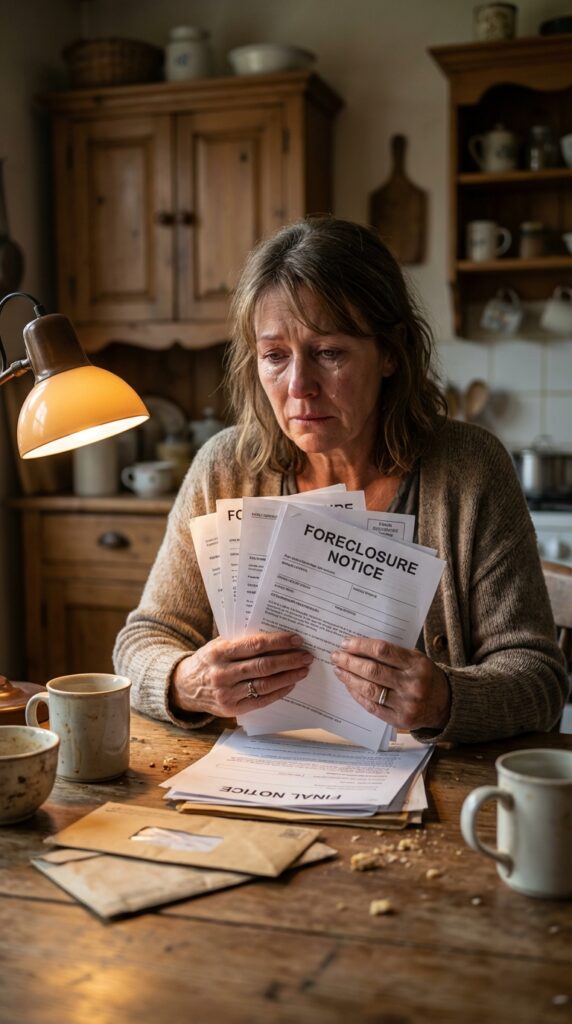
It was the official notice of foreclosure.
The bank was coming for the lighthouse.
They were coming for the porch light that had guided us home for four decades.
I stood in the foyer, the paper trembling in my hands.
The room felt suddenly vast and freezing, the air thin.
My first instinct was to call him—to shout at the empty chair in the den, to demand an explanation, to weep until my lungs burned.
I waited for the collapse, for the grief to swallow me whole.
I looked at the bank account statement—a hollow, mocking zero—and realized that the man I loved had left me with nothing but the architecture of a life he had already dismantled.
I walked to the front door and looked out at the porch.
The bulb flickered, buzzing with a dying metallic hum.
For a moment, the darkness threatened to reclaim everything.
But then, a strange, crystalline clarity washed over me.
The debt was a shackle, yes, but it was also a severance.
The house was just wood and nails, and the man who had built our security on sand was gone.
I reached out and clicked the switch, plunging the porch into darkness.
The silence of the night air felt different now—not empty, but open.
I didn’t need the light to see my way forward.
For the first time in my life, the strength wasn’t something I had to borrow from him.
It was something I had been cultivating in the quiet corners of my own heart, waiting for a winter hard enough to reveal it.
I turned back into the dark house, no longer looking for Arthur, but for the woman who would survive him.
CHAPTER 2: The Paper Trail of Shadows
The funeral flowers had barely withered, their heavy, sweet scent lingering in the hallway like a ghost that refused to depart, when the truth began to unspool.
I had spent forty years believing our life was a sturdy oak, rooted deep in the soil of mutual trust.
Arthur was the steady hand, the one who handled the ledgers and the quarterly taxes, while I tended to the garden and the warmth of our hearth.
I thought we were building a future.
It turns out, we were merely decorating a house of cards.
It started with a notice from the bank—a thick, cream-colored envelope that felt deceptively heavy.
I assumed it was a routine inquiry regarding our joint savings, the nest egg we had spoken about so often during those long, quiet evenings under the porch light.
When I tore it open, the words swam before my eyes. *Past due.* *Default.* *Notice of Intent to Foreclose.*
I sat at our kitchen table, the wood scarred by years of shared meals and spilled tea, and felt the floor drop out from beneath me.
The numbers were staggering.
Arthur, my Arthur, had been borrowing against the house for years.
There were lines of credit I had never signed for, high-interest loans disguised as business ventures that never materialized, and a mountain of interest that had grown like a strangling vine.
The betrayal wasn’t the money itself.
It was the silence.
The realization that for over a decade, my husband had been a stranger sitting across from me at breakfast, concealing a life I knew nothing about.
Every time he kissed my forehead before leaving for “the office,” every time he told me we were safe, he was burying us.
The warmth of the porch light, once a symbol of our sanctuary, suddenly felt like a lie told in the dark.
For three days, I did not leave the house.
I sat in the living room, surrounded by the remnants of a life that felt suddenly fragile.
I looked at the photos on the mantle—the two of us at the beach, the graying hair, the smiles that I now viewed with a painful, investigative eye.
Was he hiding a secret then?
Was he worried?
Or was he merely the master of a performance I had been all too eager to believe?
Anger, cold and sharp, eventually cut through the grief.
It arrived like a winter frost, clarifying the edges of my world.
I walked to the roll-top desk in the study, the one he had always kept locked, and took a small brass key from the chain around my neck—a key he had given me years ago, with a teasing wink, telling me it held “his most precious secrets.”
I had never used it.
I had respected his privacy because I respected him.
As the lock clicked open, I didn’t find jewels or hidden riches.
I found a leather-bound ledger, the ink faded, detailing the steady decay of our finances.
But tucked into the back of that ledger, beneath a stack of unpaid bills, was a smaller, yellowed envelope.
Inside was a handwritten note, dated only weeks before his heart gave out.
It wasn’t a confession; it was a map.
He had known the end was coming, and he had known I would eventually find the wreckage.
*“To my Eleanor,”* the shaky script began. *“I built a shadow, and now I leave you to face it.
You were always stronger than you knew, even when I told you otherwise to feel like your protector.
Look past the numbers.
Look at the foundation.”*
I set the letter down, my hands trembling.
The house was cold, and the silence was heavy, but for the first time in my life, I wasn’t waiting for Arthur to come home and fix it.
The inheritance he left wasn’t the debt; it was the necessity of my own survival.
The facade had collapsed, and as I looked at the bare walls of the study, I realized I was finally standing on my own two feet.
CHAPTER 3: The Ledger of Silences
The foreclosure notice arrived on a Tuesday, tucked between a grocery circular and a sympathy card that had come far too late.
It was a heavy, official-looking document, its font clinical and unforgiving.
I sat at the kitchen table, the very same oak surface where Arthur and I had spent decades mapping out our dreams.
Back then, we spoke of retirement in terms of porch swings and garden roses.
We never talked about legal notices or the hollow echo of a house that suddenly felt more like a tomb than a sanctuary.
I held the paper with trembling fingers, my vision blurring as the reality sank in.
The debt wasn’t a small oversight; it was a canyon, vast and deep, carved by years of quiet withdrawals and whispered secrets I had never been privy to.
Arthur had been the architect of our domestic peace, or so I had believed.
As I stared at the stamped red ink, the betrayal stung more sharply than the grief.
How had he managed to hide a life lived in the shadows of our shared sunshine?
For a long time, I didn’t move.
I simply listened to the rhythmic tick of the grandfather clock in the hallway, a sound that had once been the heartbeat of our home but now sounded like a countdown.
The silence of the house—usually a comfort—felt heavy, pressing against my chest.
I stood up, my knees popping with the familiar stiffness of my seventy years, and walked to the study.
It was a room I had rarely entered, Arthur’s domain of ledgers and leather-bound notebooks.
I began to clear the shelves, my movements methodical, almost mechanical.
I was stripping away the past, layer by dusty layer.
Near the back of the mahogany desk, tucked behind a heavy brass paperweight, I found it: a small, black ledger.
It was worn at the edges, the leather soft from years of handling.
I opened it, expecting to find more evidence of ruin, more proof that my marriage had been a house of cards.
Instead, I found columns of neat, cramped handwriting.
They weren’t just debts.
There were notes—painful, jagged reflections of a man who had been drowning in his own anxieties, trying to shield me from a failing business, from his pride, from his fear of being seen as anything less than the provider he promised to be.
He hadn’t been malicious; he had been broken, and in his misguided love, he had locked me out of the truth.
Tears finally spilled, tracking hot paths through the creases of my face.
I slumped into his chair, the weight of his legacy pressing down on me.
I was alone, penniless, and threatened with the loss of the only place that held the scent of our youth.
Yet, in that profound solitude, something shifted.
The betrayal still cut, but it no longer paralyzed me.
I realized that for all his attempts to protect me, Arthur had inadvertently robbed me of my own agency.
He had kept me in the dark, treating me like a fragile porcelain doll rather than a partner.
I looked at my hands—spotted with age, veined, and strong.
These hands had raised children, tended gardens, and held his through a thousand nights.
The ledger wasn’t just a record of failure; it was a map of what I had to overcome.
I didn’t need him to guide me through the dark anymore.
I had been walking beside him all those years, holding up my end of the sky, even when he pretended it was light.
I closed the ledger and placed it firmly on the desk.
I wasn’t just clearing his secrets; I was clearing the space for my own life.
The porch light would eventually go dark, and the house might be taken, but the spirit that had survived a lifetime of love and loss was not something a bank could foreclose upon.
I was old, yes, but I was finally awake.
And for the first time, the future belonged entirely to me.
CHAPTER 4: The Ledger of Echoes
The house was quieter than I ever imagined a home could be.
It was a silence that had weight, pressing against the peeling floral wallpaper of the hallway and settling like dust over the mahogany sideboard where we once kept our wedding photos.
I spent the week packing my life into cardboard boxes, each flap of tape sounding like a gunshot in the stillness.
Every object I touched was a betrayal.
A crystal vase meant for our fiftieth anniversary—one he’d purchased on credit I didn’t know existed.
A set of vintage gardening tools he’d insisted were an investment, yet were financed by a predatory lender whose name I could barely pronounce.
The house, our sanctuary under the glow of that amber porch light, had been built on a foundation of sand—or rather, a foundation of lies.
My fingers ached, stiff with the arthritis that had become my sole companion.
As I cleared out the bottom drawer of his roll-top desk—the one he’d guarded with a possessive air for decades—I found it.
Tucked behind a false panel in the back, hidden away from the world and from me, was a leather-bound ledger.
My hands trembled as I flipped through the pages.
The handwriting was his, familiar and elegant, detailing the slow, steady bleed of our security.
There were entries for “unforeseen expenses” that were clearly gambling losses, and payments to people whose names I didn’t recognize.
My heart hammered against my ribs, a painful, rhythmic protest.
The anger came, sharp and hot, but it was quickly eclipsed by a strange, hollow clarity.
He had spent our golden years dancing on a precipice, keeping me in the dark to preserve a version of himself I had never actually known.
The man who sat on the porch with me, dreaming of retirement, had been a ghost long before he actually died.
I sat on the floor, surrounded by the remnants of a thirty-year illusion.
For a long time, I wept—not for the house, not for the money, but for the time I had spent believing in a safety net that was nothing more than spun silk.
But as the evening light turned the living room into a landscape of long shadows, the weeping stopped.
I looked at my hands, gnarled and weary, and realized something profound.
All those years I thought he was the one shielding me from the world, it was actually me who had been the anchor.
I had managed the household, I had tended the garden, I had carried the emotional load while he played his dangerous games.
I had been strong enough to endure his deception without realizing it.
I closed the ledger and set it aside.
The foreclosure notice sat on the coffee table, a cruel, final decree.
A younger version of myself would have crumbled, waiting for a savior who would never arrive.
But I wasn’t that woman anymore.
I stood up, my joints protesting, and walked to the front window.
The porch light flickered, the bulb dying, casting the yard into darkness.
I didn’t reach for the switch to fix it.
I didn’t need that light anymore.
I had spent my life seeking warmth in the glow of a marriage that was fraying at the edges, but the real light—the one that guided me through the wreckage—was the one flickering inside my own chest.
I took a deep breath, the air tasting of dust and stale memories.
I would pack the last of my things.
I would walk out the front door, not as a victim of his betrayal, but as a woman who had survived the most brutal kind of poverty: the loss of a shared truth.
The debt was his.
The life ahead, however, belonged entirely to me.
And for the first time in my life, that was enough.
CHAPTER 5: The Ledger of Truth
The silence in the living room had become a physical weight, a thick, suffocating velvet that pressed against my chest.
For forty years, this room had breathed with the rhythm of Arthur’s laughter and the steady ticking of the grandfather clock in the hall.
Now, the clock was still, its pendulum stilled by my own hand weeks ago, and the air tasted of dust and cold tea.
Before me lay the ledger.
I had found it tucked behind the false back of the mahogany desk in the study—a place Arthur used to hide his favorite scotch.
I had expected to find a hidden cache of love letters or perhaps a small nest egg he’d kept for our golden years.
Instead, I found a cold, ink-stained map of his betrayals.
Page after page, the numbers told a story I hadn’t known how to read.
There were losses from investments I’d never heard of, payments to people whose names were unfamiliar, and a frantic, desperate attempt to borrow from Peter to pay Paul.
The final entries were the most painful; they were scribbled in a shaky hand, listing the mounting interest rates on the house, the very house where we had sworn our forever vows under the golden amber glow of the porch light.
He had been hiding a crumbling kingdom behind a smile that reached his eyes but never touched his soul.
I traced the line of a column where my name appeared, followed by a sum that made my stomach turn.
He had gambled with our security, yes, but he had also gambled with my trust.
The realization hit me not with a roar, but with a sharp, crystalline clarity.
The man I had grieved, the man I had painted as a saint of domestic bliss, was a man of shadows.
A sudden, sharp breeze rattled the windowpane, bringing the scent of pine and oncoming rain.
I stood up, my knees popping with the familiar protest of age.
I walked to the window and looked out at the porch light.
It flickered—a dying bulb I had been meaning to change for months.
It cast long, dancing shadows across the driveway, revealing the uneven cracks in the pavement that Arthur had always promised to fix but never did.
I didn’t cry.
The tears had been spent in the early, ignorant days of my widowhood.
Instead, a strange, cooling calm washed over me.
I realized then that the debt wasn’t just a financial burden; it was the weight of a life lived for someone else’s secrets.
I picked up the ledger and walked to the fireplace.
I didn’t burn it—that would be too dramatic, too final.
I simply set it down on the hearth, an object of paper and ink, no longer possessing the power to hurt me.
I looked at my hands.
They were spotted with age and lined with the years of hard work I had poured into this home.
I had always thought these hands were meant to support Arthur, to hold his, to mend his shirts and smooth his brow.
But they were capable of so much more.
They had raised children, kept a garden that bloomed through the harshest winters, and navigated the quiet storms of a long marriage.
The house was going to be lost to the bank.
The porch light would eventually go dark.
But as I stood there, I felt a spark ignite in the center of my chest—a fire Arthur couldn’t extinguish, because he had never owned it.
It was the inheritance of my own endurance.
I had survived the grief of his death, and I would survive the exposure of his life.
I was not the victim of these debts; I was the architect of my own survival.
I took a deep breath, and for the first time in my life, the air didn’t taste of the past.
It tasted of tomorrow.
