Table of Contents
CHAPTER 1: The Weight of an Empty Finger
The house is quiet now, a stillness that carries the rhythmic ticking of the grandfather clock in the hallway—a sound that used to be a comfort, but now feels like a slow counting of moments I spend alone.
They say that opening your heart to help someone in need is the highest form of kindness, a belief I held close even as the shadows lengthened in my twilight years.
It was that very philosophy that led me to open my door to Elena.
My joints had begun to protest the simple tasks of living, and my daughter, ever fretful, insisted I needed a set of younger hands to manage the household.
I resisted at first, guarding my independence like a weathered fortress, but eventually, I relented.
I hired Elena, a woman whose soft-spoken demeanor and weary eyes told a story of struggle I recognized all too well.
She seemed like a soul in need of a harbor, and I, in my loneliness, was happy to provide one.
Over the months, the initial wall of formality crumbled.
I found myself sharing stories of my late wife, Martha, while Elena dusted the frames that held our history.
I told her of the day we met at the autumn dance, and how her laughter was a melody that stayed with me for forty-five years.
Elena listened with a quiet, reverent intensity, nodding in all the right places, pouring tea with a gentle grace that made the house feel less cavernous.
I began to trust her—not just with the cleaning or the medication, but with the fragile, lingering presence of my memories.
Then came the Tuesday that shattered the illusion.
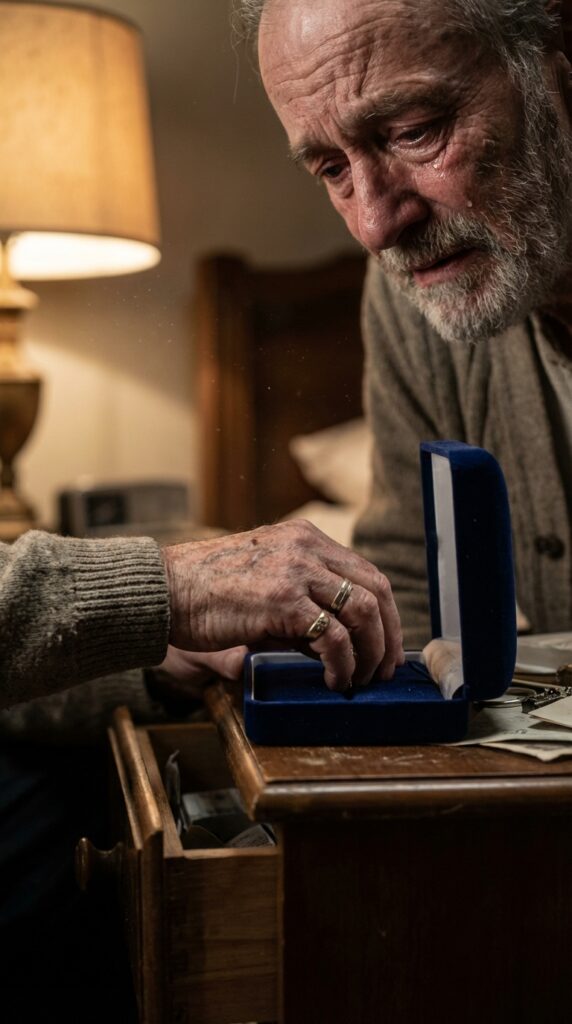
It was a morning like any other, until I reached for the small, velvet-lined box on my nightstand.
It was where I kept the one object that tethered me to my past: Martha’s wedding ring.
It was a modest band of gold, worn thin by decades of her working hands, yet it was the most precious thing I owned.
My fingers met only air and dust.
I searched the drawers, then the floor, then the entire bedroom with a frantic, pulsing dread.
It was gone.
The realization hit me not with a roar, but with a hollow, freezing silence.
I looked at the empty space on the dresser, and then I looked at the kitchen where Elena was humming a tune.
In an instant, the warmth of the home we had built together evaporated.
The betrayal stung more than the physical loss; it was a violation of the sanctuary I had invited her into.
I knew, with a sudden, sinking clarity, that it wasn’t misplaced.
It had been taken.
I sat on the edge of the bed, the silence of the house suddenly deafening.
My hand went to my own ring, turning it mindlessly.
I felt the sharp ache of anger, the urge to confront her, to demand the return of a piece of my life.
But then, I looked out the window at the garden where Martha once planted marigolds.
I realized that the ring was merely metal—forged in a factory, bought in a shop, and destined to eventually turn to dust.
My wife’s love, however, was not bound by gold.
It existed in the way the sunlight hit the floorboards, in the recipes still tucked into the kitchen drawer, and in the very beat of my own heart.
Metal is replaceable, but the love it symbolized remains forever in my heart.
Elena had stolen a trinket, yes, but she could not steal the legacy of a lifetime.
As I sat in the dimming light, I felt the sharp edges of my resentment begin to soften.
Love is stronger than loss, and perhaps, in the end, my greatest act of kindness would not be hiring her, but choosing to forgive her.
I sought a peace that no thief could ever touch.
CHAPTER 2: The Softening of Shadows
The decision to invite a stranger into the sanctity of my home was not one I made lightly.
After Clara passed, my house had become a mausoleum of memories, each piece of furniture a silent witness to a life that had suddenly, cruelly, gone quiet.
When my arthritis flared, turning the simple act of brewing tea into a grueling labor, my daughter insisted.
She spoke of “assistance” and “quality of life,” but I heard only the intrusion of a foreign presence into the sanctuary of my mourning.
Then came Elena.
She arrived on a Tuesday, carrying a small satchel and a nervous, gentle smile that didn’t quite reach her eyes.
She was younger than I expected, with hands that looked accustomed to hard work.
I watched her from my armchair, my defenses standing like iron gates.
I wanted her to be incompetent so I would have a reason to send her away, to return to the isolation that felt, in its own jagged way, like a form of loyalty to my late wife.
But weeks bled into months, and the gates began to rust.
Elena possessed an uncanny ability to navigate my grief without trampling on it.
She learned that I preferred the curtains drawn just enough to let in the afternoon light but not the harsh glare of the street.
She learned that I couldn’t bear to have my wife’s knitting chair moved, even if it collected dust.
Gradually, the house stopped feeling like an island of sorrow and began to feel like a home again.
I started leaving my door unlocked while I napped in the sunroom.
We began to talk—not about the weather or my medication, but about the humdrum beauty of existence.
She told me of her own struggles, of a family she was trying to support from afar, and I found myself offering advice I hadn’t spoken aloud in years.
I began to trust her, not with my life, but with my solitude.
It felt like a thaw after a long, bitter winter.
I convinced myself that in opening my heart to help her—by providing her with steady work and a steady wage—I was honoring the compassion Clara had always championed.
There was a strange, quiet comfort in believing that, perhaps, I wasn’t destined to wither away in bitterness.
I started to see Elena not as a caregiver, but as a bridge back to the land of the living.
I began to leave my small trinkets on the vanity—my watch, my spare keys, and most importantly, the velvet box that held Clara’s wedding ring.
It sat there, a golden anchor in a sea of memories, a symbol of the vow that death hadn’t managed to break.
I didn’t realize then that my vulnerability was being read as an invitation.
I was so caught up in the warmth of the companionship I had manufactured that I failed to notice the subtle shifts in her behavior: the lingering gazes toward the dresser, the sudden haste to finish her tasks and depart, the nervous tapping of her fingers against her thigh.
I felt safe.
I felt seen.
I felt, for the first time in an age, that I was no longer holding the weight of my life entirely alone.
I was wrong, of course.
Trust, I would soon learn, is a fragile vessel, and I had filled it to the brim with a hope that was about to shatter against the cold, hard floor of reality.
I was walking toward a cliff, and I was entirely too blind with gratitude to see the drop.
CHAPTER 3: The Fragile Architecture of Trust
For many years, the silence in this house was a heavy, suffocating shroud.
After Martha passed, the rooms felt too large, the shadows too long.
When I finally accepted that my knees and lungs could no longer navigate the stairs with the grace they once possessed, I felt a peculiar sting of defeat.
It wasn’t just the loss of physical autonomy; it was the admission that the fortress I had built for two was now crumbling.
Enter Elena.
She arrived on a Tuesday, carrying a small satchel and a smile that seemed to understand the quiet language of grief.
She was soft-spoken, with hands that moved with a practiced, rhythmic efficiency.
At first, I was a prickly shell of a man, watching her from my armchair like a hawk guarding a hollow nest.
I did not want a stranger rearranging my books or dusting the mantelpiece where Martha’s portrait sat.
I wanted my privacy.
I wanted my memories to remain undisturbed, like pressed flowers in a dusty tome.
But Elena was patient.
She possessed that rare, unhurried quality that is so often missing in the world today.
She would prepare my tea—always with a slice of lemon, just as Martha liked it—and sit in the periphery while I recounted stories of our life in London.
She listened not with the glazed eyes of a dutiful employee, but with the genuine curiosity of someone who valued the threads of another person’s history.
Slowly, the architecture of my resistance began to soften.
I started leaving my door ajar.
I began to ask her about her own life, the daughter she was putting through school, the garden she tended on her weekends.
I found myself looking forward to the chime of the doorbell at eight in the morning.
I began to believe, against my better judgment, that I had found not just a caregiver, but a companion—a bridge back to the land of the living.
It is a curious thing, trust.
It is built brick by painstaking brick over weeks of shared mornings and mundane chores, yet it possesses the structural integrity of a soap bubble.
I had given her a key to my home.
I had given her the keys to my routine, my comfort, and, in a sense, my loneliness.
I felt, for the first time in a decade, that I was no longer navigating the sunset of my life entirely alone.
One evening, after she had left, I found myself standing by the mahogany vanity in the bedroom.
It had been my ritual for years to polish the small velvet box that held Martha’s wedding ring—the delicate gold band with the tiny diamond chip that had been through the Great Depression, two moves, and forty years of marriage.
My thumb traced the spot where the box usually sat, nestled between my watch and a photo of our wedding day.
My heart skipped a beat, then performed a slow, sickening roll in my chest.
The box was light.
Too light.
I pried the velvet lid open, half-expecting to see the glint of gold, but the fabric was barren, leaving only a circular indentation—a ghost of the treasure that had rested there for so long.
A chill, sharper than any winter draft, swept through the room.
I searched the vanity, then the carpet, my hands trembling with a sudden, frantic urgency.
I checked the drawers, my breath hitching in my throat.
But the truth was a cold stone settling in my gut.
The house was locked.
The drawers were undisturbed.
And the person I had allowed into the sanctuary of my memories had reached in and taken the one thing that grounded my soul to this earth.
The silence of the house returned, but this time, it felt different.
It was no longer the silence of solitude; it was the deafening, hollow roar of betrayal.
CHAPTER 4: The Hollow Space on the Velvet
The silence of my home has always been a companion, but lately, it had begun to feel like a shroud.
After my wife, Eleanor, passed, I found that the rooms held her essence—the faint scent of lavender, the soft indentation on the sofa, and the quiet dignity of her absence.
To navigate this final chapter, I had invited Elena into my life.
She was a woman of gentle movements and a soft-spoken demeanor, someone I felt had been sent to soften the hard edges of my solitude.
Over the months, a quiet rhythm had developed between us.
I watched as she dusted the mahogany side table, her hands moving with a reverence I found comforting.
I began to trust her, not just with the mundane tasks of housekeeping, but with the fragments of my history.
I shared stories of Eleanor—how we danced under the harvest moon in ’64, how she burned the first roast we ever attempted—and Elena would listen, her eyes bright with a borrowed empathy.
I felt the winter of my isolation beginning to thaw.
The ritual was always the same.
Before bed, I would open the small, ornate music box that sat on my nightstand.
Inside, nestled on a bed of faded blue velvet, lay Eleanor’s wedding ring.
It was a simple gold band, worn thin by decades of her touch, yet it possessed the gravity of a thousand memories.
Each night, I would run my thumb over the metal, feeling the history etched into the gold, and whisper a soft “goodnight” to the ghost of my love.
But yesterday evening, the ritual was shattered.
I reached for the lid, my fingers trembling slightly with the encroaching fatigue of age.
The music box groaned open, playing its melancholic, tinkling melody.
But as my eyes adjusted to the dim lamplight, a cold, sharp shock pierced my chest.
The velvet was bare.
The hollow space where the ring had rested for thirty years gaped back at me like an open wound.
I blinked, convinced my failing vision had betrayed me, but the ring was gone.
A frantic, irrational search followed—I overturned the box, checked the floor, peered beneath the rug—but the realization settled over me with the heavy, suffocating weight of a tombstone.
Elena.
The realization didn’t come as a shout; it came as a silent, internal collapse.
She had been the one to clean this room.
She had been the one to stand closest to the memories I cherished most.
As the truth hardened in my gut, I felt a betrayal so profound it eclipsed the anger.
It wasn’t just the theft of gold; it felt like a violation of the sanctuary I had carefully constructed around Eleanor’s memory.
She had walked into my home, accepted my stories, and then reached into the most sacred corner of my life to pluck out a piece of my heart.
I sat on the edge of the bed for a long time, the music box still playing its final, dying notes.
My hands, map-lined with the years, gripped the empty air where the ring should have been.
I looked at the spot where she usually stood, the place where I had placed my trust, and found it empty.
Betrayal is a bitter medicine, one that leaves a taste of iron in the mouth.
I had opened my doors, opened my heart, and invited a stranger to witness my fragility.
In return, I was left with a loss that felt heavy, jagged, and cold.
But as the clock ticked in the hallway, marking the passage of yet another minute in this life, I looked at the empty velvet one last time.
The ring was gone—stolen, bartered, or discarded—but the love it held?
That could not be pried away.
The ring was merely metal; the promise it represented was written in the architecture of my own soul, a place no thief could ever reach.
CHAPTER 5: The Weight of Gold and the Light of Memory
The velvet lining of the mahogany jewelry box looked like an open wound.
It was a small, square void where Martha’s wedding band had rested for forty-two years.
For decades, that ring had been a constant companion—a cool, golden circle that anchored my mornings and smoothed the rough edges of my days.
Now, as I stared at the empty indentation, the silence of the house seemed to roar.
Elena, the woman I had welcomed into my home with open arms and a hopeful heart, was gone.
With her, she had taken not just a piece of jewelry, but the delicate, hard-won trust I had painstakingly built since my wife’s passing.
The betrayal was a sharp, physical sensation, a sudden tightening in my chest that made the air feel thin and stale.
How could someone who sat across from me at breakfast, listening to stories of our first anniversary in the rain, reach into my past and snatch away a piece of its physical proof?
I sat in my armchair, the one with the worn fabric where Martha used to curl up with her novels, and closed my eyes.
At first, the anger was a wildfire, consuming everything in its path.
I felt foolish for my openness, betrayed by my own kindness.
I had sought help to navigate the loneliness of my twilight years, and in return, I had been robbed of the very symbol of the love that defined my life.
But as the afternoon sun began to stretch long, amber fingers across the hardwood floor, the fire began to cool into a steady, thoughtful warmth.
I looked at the spot where the ring had been, and then I looked at my own trembling hands.
I realized then that the thief had only ever managed to touch the surface of my life.
She had taken the gold, the cold metal that was mined from the earth and fashioned by machines.
She had taken the band that was merely a vessel for the memories I held.
But she could not touch the love itself.
The love I felt for Martha was not trapped in a circular band of precious metal; it was woven into the way I made my tea in the mornings, the way I hummed our favorite songs when I thought no one was listening, and the way I felt her presence in the quiet moments of the dusk.
Metal is replaceable.
It is subject to the whims of thieves and the erosion of time.
But love?
Love is the one thing that remains impervious to theft.
It is etched into the architecture of the soul, far beyond the reach of any person’s greed.
The ring was a shadow of our commitment, but the light that cast that shadow was still burning, bright and eternal, within me.
I stood up, my knees aching slightly, and walked to the window to watch the neighborhood children playing in the street.
I felt a strange, profound sense of release.
If I clung to the anger, I would be letting that woman continue to rob me—not of gold, but of my peace.
If I chose to forgive, I would be reclaiming the sanctity of my own heart.
True kindness, I realized, does not depend on the recipient’s worthiness; it depends on the giver’s character.
I had opened my door to someone in need, and though she had broken that covenant, I would not let her break me.
I would hold onto the love, for that is the only legacy that truly matters.
Loss is an inevitable companion in a long life, but love—love is the constant, the anchor, and the victory.
I could let the ring go, because Martha never truly left, and no thief could ever steal the memories that keep her alive within my heart.
