Table of Contents
CHAPTER 1: The Grey Window and The Empty Pocket
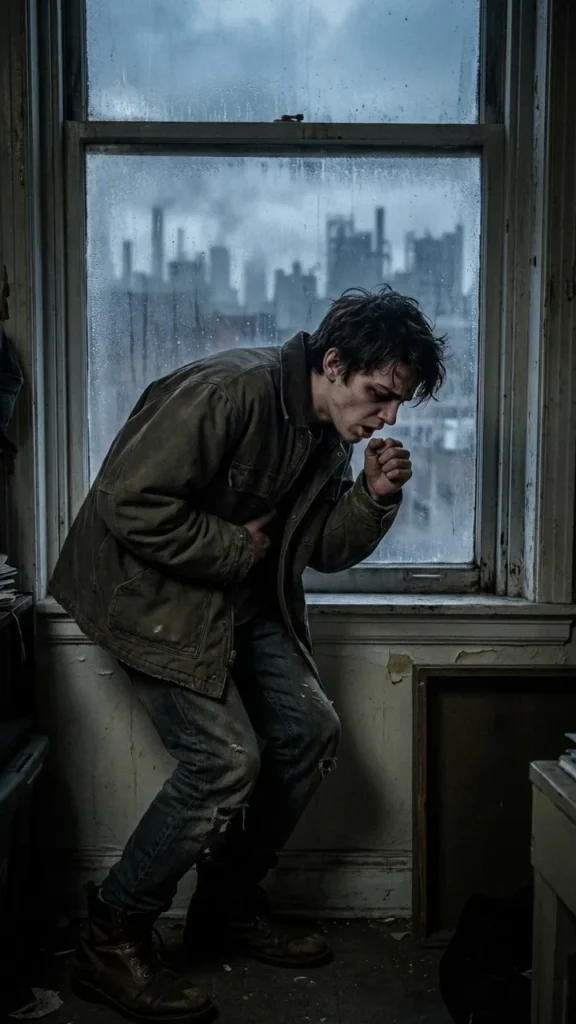
The pre-dawn chill bit through Leo’s threadbare jacket.
Sixteen years old.
Orphaned.
His world was framed by a single, grimy pane of glass.
A grey window.
It offered a bleak panorama.
Smog-choked buildings.
Empty streets.
The city, still asleep, seemed to hold its breath.
Leo was already awake.
He had to be.
His earnings depended on it.
He coughed.
A dry, rasping sound.
It rattled deep in his chest, a sound that felt too old for his young body.
His hand instinctively went to his ribs, pressing hard.
His lungs burned.
A dull, constant ache.
He ignored it.
He had to.
He counted the crumpled bills and scattered coins on the scarred Formica tabletop.
His meager bounty.
A day’s worth of early morning sprints.
Of hawking papers to indifferent faces.
Not enough.
It was never enough.
The knot of anxiety tightened in his stomach.
He needed medicine.
He knew it.
The persistent cough, the burning in his chest, were constant reminders.
But the hospital.
The word itself was a barrier.
Insurance.
He had none.
He remembered the sterile smell of the clinic.
The dismissive tone of the receptionist.
Her eyes, glazed over, hadn’t met his. “No insurance, no treatment,” she’d said, her voice flat.
The words had echoed in the empty waiting room.
Like a verdict.
He’d left, the rejection a heavier weight than the rattling in his lungs.
He stood by the window, his breath misting the glass.
The first hint of grey light began to paint the sky.
It offered no warmth.
Only a promise of another day.
Another day of struggle.
Another day of the grey world outside and the gnawing emptiness inside.
He coughed again, a weaker, more painful sound this time.
His fingers, raw from the cold and the rough newsprint, traced the condensation on the windowpane.
He drew a jagged line.
A solitary, broken path.
He pulled on his worn boots.
The leather cracked with each movement.
They offered little protection against the biting wind.
He grabbed his canvas bag.
The newspaper headlines screamed about crime and politics.
Worlds away from his own small, desperate reality.
He needed something stronger than a granola bar.
Something that cost more than a handful of change.
He thought of the pharmacy.
The brightly lit shelves.
The promise of relief.
But the price tags were a cruel joke.
A week’s earnings for a single bottle of cough syrup.
A month’s for something that might truly help.
He didn’t have a month.
He didn’t even have a week.
The memory of the clinic returned, sharp and unwelcome.
The polite indifference.
The cold, hard logic of bureaucracy. “No insurance, no treatment.” It was a mantra he couldn’t escape.
It was the wall that stood between him and the breath he so desperately needed.
He looked at his reflection in the dark glass.
A pale, thin face stared back.
Dark circles under his eyes.
A persistent cough that seemed to be stealing his strength.
He was sixteen.
He should be worrying about homework.
About girls.
About the future.
Instead, he was counting pennies.
Praying for a miracle.
Or at least, a discount.
The city was starting to stir.
A distant siren wailed.
A truck rumbled by.
The world outside his window was slowly coming to life.
But Leo felt like he was still trapped in the dying embers of the night.
The grey held him captive.
The empty pocket was his constant companion.
He took a deep, shuddering breath.
It was shallow.
Painful.
He needed to go.
The papers wouldn’t sell themselves.
And his lungs wouldn’t heal on their own.
But who would help a boy with no money?
Who would see past the worn clothes and the hacking cough to the person trapped beneath?
The grey world offered no answers.
Only more questions.
And the ever-present, burning ache in his chest.
CHAPTER 2: The Digital Venom
The city throbbed.
A symphony of impatience.
Horns blared.
A thousand footsteps hammered the pavement.
Each one a frantic beat.
Leo, small and hunched, navigated the human tide.
Potential.
Possibility.
Things he couldn’t afford.
Things he couldn’t grasp.
A harsh laugh ripped through the din.
Leo flinched.
He looked up.
A knot of teenagers, slick with an air of careless cruelty, surrounded a man huddled on the grimy sidewalk.
The man’s clothes were rags.
His eyes were vacant.
He clutched a cardboard sign. “Anything helps,” it read.
Barely legible.
One of the teenagers, a boy with a sneer etched onto his face, raised a phone.
His name was Marcus.
Leo knew that name.
A whisper in the schoolyard.
A shadow online. “AnonymousScourge.” His weapon was digital.
His targets, the vulnerable.
Marcus’s phone glowed.
He was live-streaming.
He shoved the phone closer to the homeless man’s face.
“Hey, look at this guy,” Marcus taunted.
His voice, amplified by the phone’s speaker, was a venomous hiss. “Pathetic, right?
Living on handouts.”
The homeless man flinched.
He tried to shrink away.
His shoulders hunched further.
Humiliation washed over him.
Exposed.
To a faceless audience.
His dignity stripped bare.
Leo’s fists clenched.
A surge of raw anger burned through him.
Hotter than the ache in his chest.
He wanted to shout.
To intervene.
But his voice caught in his throat.
Fear, cold and sharp, pricked at him.
He was just another nobody.
Invisible.
Marcus’s laughter escalated.
A braying, triumphant sound.
He spun the phone, capturing his own smug face. “Got him.
Classic Scourge at work.”
Later that day, the ache in Leo’s chest felt like a physical blow.
He’d managed to sell a few more papers.
A few coins jingled, a pathetic amount.
Not enough.
Never enough.
He sat on a stoop, trying to catch his breath.
The city’s noise seemed to recede.
Replaced by the ragged sound of his own breathing.
He pulled out his worn phone.
A relic from a charity drive.
He scrolled through social media.
A distraction.
A desperate attempt to escape the gnawing reality.
Then he saw it.
A new post.
From “AnonymousScourge.”
It was an image.
A doctored photo.
Of him.
Leo.
His worn jacket.
His too-short pants.
Enlarged.
Distorted.
Made to look grotesque.
Underneath, a caption: “Meet the city’s most pathetic beggar.
Too proud to beg, too poor to live.”
The comments flooded in.
A torrent of abuse.
“LOL.
Look at his face.”
“What a loser.”
“He looks like he smells.”
“Scourge, you’re the best!”
“Burn him!”
Leo’s vision blurred.
Not from tears.
From pain.
The digital venom was as potent as any physical attack.
It burrowed deep.
It festered.
His lungs burned.
He coughed, a dry, rasping sound that no one heard.
The world outside his window was grey.
Now, the world inside him felt just as desolate.
Marcus had found him.
And he was ready to tear him apart.
Piece by piece.
For the amusement of strangers.
For the thrill of his own digital power.
CHAPTER 3: The Stranger’s Hand
Leo slumped onto a park bench.
It was cold, the metal biting through his thin jacket.
His breath hitched.
Each inhale was a fight.
The coughing returned, deeper this time.
A raw, tearing sound.
He clutched his chest, his knuckles white.
Pain shot through him.
He felt lightheaded.
The world swam.
A woman stopped.
She stood a few feet away.
Her eyes were wide.
Concern etched on her face.
She had kind eyes.
Too kind for this harsh city.
“Are you okay?” Her voice was soft.
A stark contrast to the city’s roar.
Leo tried to answer.
His throat was dry.
A desert.
He shook his head.
No words came.
Only the rasp of his struggling breath.
She took a hesitant step closer.
Her gaze scanned him.
She saw the worn clothes.
The tremor in his hands.
The desperation in his eyes.
She didn’t flinch.
“You look like you need something,” she said.
Her voice was gentle.
Not pitying.
Just… present.
She rummaged in her bag.
A half-eaten granola bar.
Wrapped in crinkling foil.
She held it out.
“Here.
Take it.”
Leo’s hand trembled as he reached for it.
His fingers brushed hers.
A fleeting contact.
He managed a weak nod.
“Thank you,” he croaked.
The sound barely audible.
She didn’t move away.
She watched him unwrap the bar.
His hands shook so badly.
He broke a piece off.
It felt like sawdust in his mouth.
But it was something.
Fuel.
“My name is Sarah,” she offered.
She didn’t press for his.
It was a silent offer of connection.
Leo swallowed.
Another painful effort.
He couldn’t look at her directly.
He focused on the worn bench beneath him.
“I can… I can call someone,” Sarah said.
Her brow furrowed. “An ambulance?
Or… do you have family?”
Leo squeezed his eyes shut.
Family.
The word was a phantom.
A ghost.
He pictured the clinic.
The cold dismissive stare. “No insurance, no treatment.” The words echoed.
He shook his head again.
A violent tremor.
Sarah saw his fear.
His raw vulnerability.
Something in his pleading eyes.
They were so old.
Too old for a teenager.
“What is it?” she asked.
Her voice was urgent now. “Tell me what’s wrong.”
Leo opened his eyes.
He looked at Sarah.
Really looked.
She had a small scar above her left eyebrow.
Her hair was pulled back in a messy ponytail.
She looked… real.
Not like the faces that usually blurred past him.
He opened his mouth.
He wanted to explain.
The burning in his chest.
The darkness that sometimes swallowed him whole.
But the words refused to form.
A wall of fear and pain.
Sarah watched him struggle.
She saw the panic rising in his eyes.
She didn’t understand.
But she felt it.
The sheer helplessness radiating from him.
It was palpable.
A suffocating weight.
“Is it… is it money?” she ventured.
She didn’t want to assume.
But she’d seen enough.
Enough of the city’s sharp edges.
Leo’s gaze snapped to hers.
A flicker of surprise.
Then resignation.
He gave a slow, painful nod.
His chest heaved.
“I… I need medicine,” he finally managed.
The words were a painful confession.
A surrender.
Sarah’s jaw tightened.
She understood.
The cruel economics of survival.
The healthcare system’s unforgiving maw.
“Medicine?” she repeated.
Her voice was tight. “What kind of medicine?”
Leo’s eyes darted around the park.
As if afraid someone would overhear.
He lowered his voice.
It was barely a whisper.
“For my lungs.
They… they hurt.
All the time.” He coughed again.
This one was shorter.
But it wracked his whole body.
Sarah’s eyes narrowed.
She was a coder.
Her mind worked in patterns.
In logic.
But this was beyond logic.
This was human suffering.
Bare and exposed.
“You’ve been to a doctor?” she asked.
Her voice was low.
Intense.
Leo swallowed. “Tried.
They… they said no insurance.
No help.” The words were a bitter pill.
He’d rehearsed them in his mind.
A thousand times.
Sarah stood perfectly still.
Her mind racing.
She’d seen this before.
Not directly.
But she’d heard the whispers.
The hushed conversations.
The quiet desperation of those on the fringes.
“They turned you away?” Sarah’s voice was laced with disbelief.
And a growing anger.
Leo nodded again.
He looked down at his hands.
He traced the lines on his palm.
A map of his own neglect.
“It’s… it’s not that bad, is it?” he asked.
His voice was laced with a false bravado.
A desperate attempt to minimize his own pain.
To not be a burden.
Sarah knelt down in front of him.
She brought her face level with his.
Her gaze was unwavering.
“Don’t.
Don’t say that,” she said.
Her voice was firm. “It sounds like it’s very bad.”
Leo’s vision blurred.
The pain in his chest intensified.
The granola bar lay forgotten in his lap.
He felt a wave of nausea.
“I… I can’t,” he gasped.
His lungs burned.
Fire.
Like embers being fanned.
Sarah saw the color drain from his face.
His skin took on a greyish pallor.
It mirrored the sky.
His window.
His world.
“Okay.
Okay, stay with me,” Sarah said.
Her voice was a lifeline.
She looked around frantically.
No one seemed to notice.
The city’s relentless indifference.
She reached into her pocket.
Pulled out her phone.
Her fingers flew across the screen.
She wasn’t calling for an ambulance.
Not yet.
She needed more information.
“Who did they say couldn’t help you?” she asked.
Her eyes scanned the phone’s display.
She was already searching.
Building a digital trail.
Leo stared at her.
He didn’t understand.
Why was she helping him?
Why was she asking questions?
No one ever asked questions.
Not like this.
“The clinic,” he whispered. “The one… downtown.
Near the market.”
Sarah typed furiously. “Clinic on Elm Street?”
Leo nodded.
A small, jerky movement.
“And who… who told you no?” Sarah’s fingers paused.
She looked directly at him.
Her gaze was piercing.
“A… a woman.
In a white coat,” Leo managed.
He coughed again.
A hollow, painful sound.
Sarah’s lips thinned.
She recognized the pattern.
The systemic neglect.
The casual cruelty.
“Alright,” she said.
She stood up.
Her movements were decisive. “I think I can help.”
Leo watched her.
A flicker of hope.
A dangerous, fragile thing.
He’d learned to suppress it.
But seeing Sarah… it was hard.
“How?” he asked.
His voice was hoarse.
Filled with a desperate plea.
Sarah looked at him.
Her expression was a mixture of determination and something akin to rage. “I have a few… connections.
In the digital world.
And I have a nose for injustice.”
She gave him a small, reassuring smile.
It didn’t quite reach her eyes.
“Just… rest here.
Try to breathe.
I’ll be back.”
And with that, Sarah turned and walked away.
Her figure disappearing into the throng of indifferent faces.
Leaving Leo alone.
On the cold park bench.
With the burning in his chest.
And a fragile seed of hope.
Planted by a stranger’s hand.
A hand that didn’t flinch.
A hand that offered more than just a granola bar.
It offered the promise of something more.
Something he desperately needed.
A fight.
CHAPTER 4: The Digital Echo
Sarah’s gaze lingered on Leo, a raw, desperate plea in his eyes.
The woman’s granola bar was gone, but the tremor in Leo’s hands remained.
The coughing fit that had wracked his small frame hadn’t subsided, only quieted to a painful rasp.
Sarah’s own breath hitched.
It wasn’t just about a hungry kid.
Something was deeply wrong.
She’d seen the same haunted look before.
The look of someone trapped.
Sarah’s fingers, nimble from years spent coaxing code from lines of text, drummed a restless rhythm on her thigh.
Her apartment was a chaotic sanctuary of blinking monitors and overflowing coffee mugs.
Freelance coding was her life.
It paid the bills.
Mostly.
She knew the sting of being just outside the system.
“Are you sure you don’t need anyone?” Sarah asked again, her voice a low murmur against the city’s roar.
Leo’s eyes, a startling blue against his pale face, met hers.
He swallowed hard.
A ragged breath escaped him.
He shook his head, a weak, almost imperceptible movement.
Sarah’s brow furrowed.
She felt a prickle of unease, a familiar sensation that often preceded a digital rabbit hole.
Leo’s helplessness was a siren song to her investigative nature.
She had a knack for piecing together fragments, for seeing the patterns others missed.
Her freelance work demanded it.
Digital forensics was a second language.
She stood, offering Leo a small, encouraging smile. “Alright,” she said. “I’ll be back in a bit.
Just… stay put.
Okay?”
Leo’s lips parted, a silent acknowledgment.
He watched her go, his chest still tight, each inhale a victory.
Sarah walked quickly, her worn sneakers slapping against the grimy pavement.
The city hummed with its usual frantic energy.
Delivery trucks roared past, their engines a guttural growl.
Pedestrians, a kaleidoscope of hurried faces, navigated the sidewalks with practiced indifference.
But Sarah saw only Leo’s pale face, his shaking hands.
She pulled out her phone, its screen a familiar beacon in the urban chaos.
The name “AnonymousScourge” flashed in her mind.
Marcus.
The name always came with a sneer.
A cruel, gleeful sneer she’d seen plastered across countless online forums.
She’d encountered his digital venom before, usually targeting smaller, less visible communities.
But this felt different.
This felt… personal.
“Let’s see what you’re up to, Scourge,” Sarah muttered, her thumb flying across the screen.
Her search was a surgical strike.
She bypassed the superficial.
She delved into the dark corners of social media, the forgotten forums, the ephemeral chat rooms.
AnonymousScourge’s digital footprint was vast, a trail of digital breadcrumbs leading to a cesspool of online cruelty.
She found the live stream.
The homeless man, his face a mask of shame, shrinking under the blinding glare of Marcus’s phone.
The jeering comments scrolled by, a sickening wave of digital bile.
Sarah’s stomach churned.
Then, she saw it.
The doctored image of Leo.
His worn clothes, his gaunt frame, twisted into a grotesque caricature.
The comments beneath it were a symphony of taunts, a chorus of digital hyenas tearing into a defenseless prey.
Sarah’s jaw tightened.
The spark of concern ignited into a burning ember of righteous anger.
She dug deeper.
Marcus’s other accounts, his usual targets.
A bullied classmate.
A teacher who’d dared to challenge him.
A rival gamer.
The pattern was sickeningly clear.
Marcus thrived on inflicting pain.
He was a digital predator, a coward hiding behind a keyboard.
Then, Sarah found the hidden forum.
A private corner of the internet where AnonymousScourge and his ilk exchanged war stories.
Boasts about their “victories.” Their methods.
Their justifications.
It was a twisted meritocracy of meanness.
Sarah scrolled through pages of venom, her fingers growing cold.
And then, she found something else.
Buried deep, a deleted post, marked for archival only.
It wasn’t from Marcus.
It was from an anonymous user.
The tone was different.
Desperate.
Frightened.
“URGENT HELP NEEDED.
HOSPITAL REFUSES TREATMENT.
NO INSURANCE.
PHYSICIAN: DR.
ELARA VANCE.
WARD: PEDIATRIC RESPIRATORY.
POLICY AGAINST NON-EMERGENCY CARE FOR UNINSURED.
MY SON IS DYING.”
Sarah’s breath hitched.
Her blood ran cold.
Pediatric Respiratory.
Dr. Elara Vance.
The policy.
It was all there.
The deleted post was a ghost of a cry for help.
A cry that had been ignored.
A cry that echoed Leo’s silent desperation.
Sarah’s fingers flew.
She cross-referenced Dr. Elara Vance’s hospital affiliation.
A quick search confirmed it.
St.
Jude’s.
The very hospital Leo had likely tried and failed to get help from.
The connection was undeniable.
Leo wasn’t just a victim of a cyber-bully.
He was a victim of a systemic injustice.
The phone felt heavy in Sarah’s hand.
The city noise faded.
All she could hear was the echo of that desperate plea.
A plea that mirrored the rasp in Leo’s chest.
Sarah didn’t hesitate.
The anger that had simmered within her now boiled over into a fierce determination.
She stood abruptly, her decision made.
The digital breadcrumbs had led her to a horrifying truth.
Now, she had to bring it to light.
She hailed a cab, the city lights blurring outside the window.
Her mind raced.
She rehearsed the words.
The evidence.
The video.
The deleted post.
Dr. Vance.
The policy.
The sheer, unadulterated cruelty of it all.
The cab screeched to a halt outside the imposing edifice of St.
Jude’s Hospital.
The air inside was sterile, a stark contrast to the city’s grit.
Sarah marched through the gleaming lobby, her gaze fixed.
She bypassed the reception desk, heading straight for the administrative offices.
She found the administrator.
A woman with sharp eyes and an even sharper suit.
Ms. Albright.
“I need to see you,” Sarah said, her voice cutting through the hushed efficiency.
Ms. Albright looked up, her expression one of mild annoyance. “Do you have an appointment?”
“No,” Sarah stated, her tone unwavering. “But I have something you need to see.
Something you need to hear.”
Sarah sat opposite Ms. Albright, her phone laid out on the polished mahogany desk.
She played the video first.
The homeless man’s humiliation.
The jeers of the online mob.
Ms. Albright’s eyes narrowed.
“This is… an unfortunate incident,” Ms. Albright said, her voice carefully neutral. “But it has no bearing on hospital policy.”
Sarah’s lips thinned. “Oh, it has bearing,” she replied, her voice dangerously calm.
She then displayed the deleted post.
The raw desperation.
The specific details.
Dr. Vance’s name.
The ward.
The policy.
Ms. Albright’s composure began to crack.
Her eyes darted nervously.
A faint sheen of sweat appeared on her forehead. “This is… a private matter,” she stammered, her voice losing its steely edge. “Patient confidentiality…”
“Confidentiality?” Sarah’s voice rose, sharper now. “When a child is denied life-saving treatment because of a lack of insurance?
That’s not a private matter.
That’s a public scandal waiting to happen.”
Ms. Albright stood, her face pale. “I will not be threatened.”
“It’s not a threat,” Sarah said, her voice a low growl. “It’s a promise.
This story is about to go viral.
And St.
Jude’s will be front and center.
Unless you make this right.”
Sarah didn’t wait for a response.
She was already on her phone, her fingers a blur.
She sent the video, the post, the damning details to every reporter, every news outlet, every online activist group she could think of.
She tagged St.
Jude’s, Dr. Vance, Ms. Albright.
She unleashed the digital echo.
The story exploded.
The hashtag #StJudesInjustice trended within minutes.
The hospital’s social media feeds were flooded with outrage.
The carefully constructed facade of compassion crumbled under the weight of public condemnation.
Within hours, the wheels of bureaucracy, so slow to act for Leo, began to spin with unprecedented speed.
Leo was admitted.
Treated.
The anonymous plea had finally been heard, amplified by Sarah’s courage and the roar of public opinion.
Marcus, exposed for his cowardly online attacks, faced swift and severe consequences.
His anonymity evaporated.
His digital venom turned back on him.
His future, once brimming with malicious glee, was suddenly uncertain.
A week later, Sarah sat by Leo’s bedside.
The harsh, rasping cough was gone, replaced by the gentle rhythm of steady breathing.
His color had returned.
His eyes, still a startling blue, held a spark of life that had been absent before.
He looked at Sarah, a genuine, unforced smile gracing his lips.
The grey world he had known, the one he saw through his apartment window, was now tinged with hues of possibility.
Kindness, a force he had almost forgotten, had not only offered him a granola bar.
It had offered him his cure.
CHAPTER 5: The Reckoning and The Cure
Sarah’s hands trembled as she clutched the tablet.
The hospital’s polished chrome and sterile scent felt alien, a stark contrast to the gritty reality she’d uncovered.
She pushed open the heavy door marked “Administration.”
A woman sat behind a mahogany desk.
Ms. Albright.
Her name tag gleamed.
Her expression was one of practiced patience.
“Can I help you?” Ms. Albright’s voice was smooth, devoid of warmth.
Sarah’s throat felt thick.
She swallowed. “I need to speak with you.
Urgently.”
Ms. Albright’s eyes, a pale, washed-out blue, flickered over Sarah’s worn jeans.
Disdain, subtle but present. “I’m very busy.”
“It concerns a patient,” Sarah stated, her voice gaining a steely edge. “Leo.
Sixteen.
Admitted yesterday.”
Ms. Albright’s posture stiffened.
A tiny muscle twitched in her jaw. “Patient privacy is paramount.
I cannot discuss individual cases.”
Sarah slid the tablet across the desk.
The screen glowed.
The video of the homeless man’s humiliation flickered.
Ms. Albright’s eyes widened, then narrowed.
“What is this?” she demanded, her voice sharp.
“This is Marcus. ‘AnonymousScourge.’ He films vulnerable people.
He profits from their pain.” Sarah pointed to the screen. “He posted this live.
Then, he doctored this image.” She tapped the screen, revealing Leo’s mocked face.
Ms. Albright’s knuckles whitened as she gripped the desk. “This is… an unfortunate incident.
We will look into it.”
“Unfortunate?
He’s a cyber-bully.
And he’s not the only one your hospital protects.” Sarah scrolled to the next image.
The deleted post, salvaged from the digital ether.
The anonymous plea for help.
The specific ward.
The doctor’s name: Dr. Evans.
The damning mention of refusing uninsured patients for non-emergency care.
“Dr. Evans refused to treat Leo,” Sarah stated, her voice a low growl. “Because he had no insurance.
Leo is dying, Ms. Albright.
Dying.
And you denied him care.”
Ms. Albright’s face drained of color.
Her carefully constructed composure crumbled.
Her eyes darted from Sarah to the tablet, then to the door as if seeking an escape. “This is… a complex situation.
Hospital policy…”
“Policy?” Sarah’s laughter was a harsh, broken sound. “Your policy is a death sentence for kids like Leo.
For people like him.” She gestured vaguely, encompassing the unseen city beyond the window.
Ms. Albright wrung her hands. “The hospital is a business.
We have financial obligations.”
“And Leo has a right to live!” Sarah’s voice boomed, echoing in the quiet office.
She leaned forward, her gaze fierce. “You think you can hide this?
You think the world won’t see what you’re doing?”
She picked up her tablet.
Her fingers flew across the screen. “This is going viral, Ms. Albright.
Every social media platform.
Every news outlet.
Your ‘private matter’ will be front-page news.
The story of the hospital that lets children die because they can’t afford your exorbitant fees.”
Ms. Albright paled further.
Her breath hitched. “Please.
You can’t.
Think of the hospital’s reputation.”
“Your reputation is already in tatters,” Sarah countered, her voice cold. “You made it so when you turned Leo away.
When you prioritized profit over a child’s life.” She stood, the tablet held like a weapon. “I’m calling the press.
I’m calling every reporter I know.
You have exactly ten minutes to get Leo the treatment he deserves.
Or this entire building will be swarmed.”
Panic flared in Ms. Albright’s eyes.
She fumbled for a phone. “Wait.
Don’t do anything rash.
I’ll… I’ll make a call.”
The next few hours were a blur of frantic activity.
Sarah, using her extensive network of journalist contacts and her own considerable online following, orchestrated a social media storm.
Hashtags like #HospitalOfShame and #JusticeForLeo trended worldwide.
The video of the homeless man, coupled with Leo’s story and the damning deleted post, ignited public outrage.
Within an hour, the hospital administration was in crisis mode.
News crews gathered outside.
Lawyers were consulted.
The pressure was immense, a tidal wave of public condemnation.
Ms. Albright, her face a mask of terror, personally oversaw Leo’s transfer to a private room.
Dr. Evans was suspended indefinitely.
The next day, the sterile scent of the hospital still clung to the air, but it was less oppressive.
Leo lay in a clean bed, his breathing easier.
The rattling cough was gone, replaced by the steady rhythm of healing.
He looked weaker, but the hollowed look in his eyes had receded.
Sarah found him staring out the window.
The light, softened by the morning mist, painted the cityscape in gentle shades of grey and gold.
“How are you feeling?” Sarah asked, her voice soft.
Leo turned.
His gaze met hers, and for the first time, she saw it.
A genuine, unforced smile.
It was small, but it radiated a warmth that chased away the last vestiges of the cold she’d felt in this place.
“Better,” he whispered, his voice still raspy, but clear. “So much better.” He clutched his chest, not in pain, but in a gesture of relief.
“They’re taking care of you,” Sarah said. “The treatment is working.”
“You did this,” Leo said, his eyes filled with gratitude. “You.
You didn’t have to.
You didn’t know me.”
“I saw you,” Sarah corrected gently. “And I saw what they were doing.
Nobody should be treated like that.” She sat on the edge of his bed. “And Marcus…”
“They found him,” Leo said, a flicker of something that might have been satisfaction in his eyes. “My… the person who posted about me online.
Someone saw him.
He’s being investigated.”
“Good,” Sarah said, a quiet fierceness in her tone. “No one should be allowed to hurt others like that.
Not online, not anywhere.”
Leo looked back at the window. “It’s… different now.
The view.”
Sarah followed his gaze.
The same buildings, the same sky.
But the world felt altered. “What’s different?”
“It’s not just grey anymore,” Leo said. “There’s… color.
I can see it.
Like you said.
Possibility.” He looked back at Sarah, his smile widening. “Thank you.
For everything.”
Sarah reached out and gently squeezed his hand.
His skin was still cool, but there was a new strength there. “You saved yourself, Leo.
You just needed someone to see you.”
The grey world he had known, the one he saw through his apartment window, was now tinged with hues of possibility.
Kindness, a force he had almost forgotten, had not only offered him a granola bar.
It had offered him his cure.
